Cross-Border Space Structuring Platform

From Industrial Sector to National Power: China’s Space Strategy Shift (14th to 15th Five-Year Plan)
David Dong
3/15/20262 min read
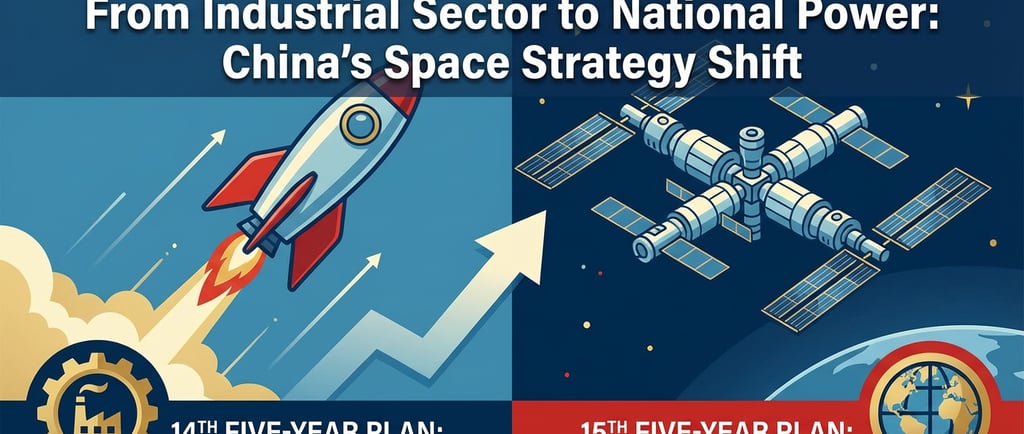
On March 13, the full text of the "Outline of the 15th Five-Year Plan for National Economic and Social Development of the People's Republic of China" was publicly released. The nearly 60,000-word Chinese text is quite concise and refined. Focusing on the themes of Hong Kong and the space economy, I plan to analyze this in three short articles. The first article will analyze the differences between this year's 15th Five-Year Plan and the previous 14th Five-Year Plan's direct statements concerning aerospace. The second article will analyze what other aspects of the 15th Five-Year Plan, besides the development of the aerospace industry itself, are essentially conducive to the development of the space economy. The third article will analyze the important role Hong Kong can play in the space economy over the next five years, considering Hong Kong's characteristics and national positioning.
China’s transition from the 14th Five-Year Plan (2021–2025) to the 15th Five-Year Plan (2026–2030) reveals a profound strategic upgrade in how the country conceptualizes space development. The shift is not simply about funding more rockets or satellites. It represents a structural transformation: From “space as a strategic emerging industry” to “space as a pillar of national power.” This evolution reflects deeper ambitions: technological sovereignty, systems integration, digital infrastructure dominance, and global governance participation.
1. Strategic Positioning: From Industry to National Capability
14th Five-Year Plan
Aerospace categorized as a strategic emerging industry
Focus on breakthroughs in space technology
Emphasis on technological catching-up
Space projects embedded in innovation strategy
15th Five-Year Plan
Explicit goal: Build a “Space Power”
Space placed alongside “Manufacturing Power” and “Network Power”
Elevated to a comprehensive national strength objective
Integrated into state capability architecture
2. From Construction to Systems Engineering
The 14th Plan focused primarily on building components of space infrastructure. The 15th Plan shifts toward integrated system orchestration.
14th Plan Focus
Commercial launch site development
Satellite navigation and remote sensing expansion
Industrial ecosystem cultivation
Technology R&D in deep space and heavy launch
15th Plan Focus
Low Earth Orbit satellite constellation deployment
Air-Space-Ground integrated network
Coordinated civil space infrastructure planning
Large-scale application rollout
3. Digital Integration: Space as Infrastructure Backbone
Under the 14th Plan, space infrastructure was categorized within new infrastructure. Under the 15th Plan, space becomes foundational to digital China.
Satellite internet integrated with national computing networks
Space systems embedded into AI, data governance, and digital sovereignty
Air-space-ground architecture positioned as strategic infrastructure
4. From Participation to Rule-Shaping
Another major shift lies in international positioning.
14th Plan
Participation in global deep space missions
Space cooperation within Belt & Road
Technology collaboration emphasis
15th Plan
Proposing international governance frameworks for outer space
International lunar research station initiatives
Participation in global rule-setting
5. Evolution of Core Strategic Language
The transformation can be summarized in a progression of policy language: Breakthrough → System Construction → Coordination Application → Constellation Participation → Rule Shaping Industry → National Power
Structural Comparison Diagram
14th Five-Year Plan (2021–2025)
Strategic Emerging Industry
Technology Breakthrough
Infrastructure Construction
Industrial Ecosystem Formation
Global Participation
15th Five-Year Plan (2026–2030)
Space Power Objective
System-Level Integration
LEO Constellation Deployment
Air-Space-Ground Network
Global Rule Influence
⬇ Strategic Elevation ⬇
Strategic Implication
Space becomes foundational state infrastructure
Integration with defense, digital economy, and industrial chains
Transition from project-based development to network-based dominance
Elevation from industrial growth driver to geopolitical capability
Conclusion
If the 14th Five-Year Plan marked China’s transition from technological catching-up to industrial scaling in aerospace, the 15th Five-Year Plan signals a new phase: systemic space capability as a pillar of national power.
This shift aligns space development with digital sovereignty, supply chain security, strategic deterrence, and global governance ambition. China’s space policy is no longer primarily about launching satellites. It is about architecting systems.
For global investors, policymakers, and aerospace leaders, the 15th Plan indicates that China’s space strategy is moving from industrial expansion to structural dominance.